The focus of today’s trip was all about Gaudi and his architecture.
Our first stop was of course his pièce de résistance, the La Sagrada Familia. It is the largest Catholic church in the world under construction. Building started in March 1882 and a few weeks ago, on February 2026, it became the tallest church in the world. There is still many years of construction to go.
The outside is very ornate and tells all these biblical stories in dioramas of stone.
It is the inside that takes your breath away and makes you feel that you have been transported to a different place and time.
To quote: “It is a monument to Light”
And everything you see has a symbolic attachment to faith.
After a drive through town past some of Gaudi’s other great pieces, we got to Park Guell where he was commissioned to do a neighborhood of whimsical places in a park for the Nouveau Riche.
A fascinating day.


There is no photo that can convey the sheer drama and transformation entering this space.


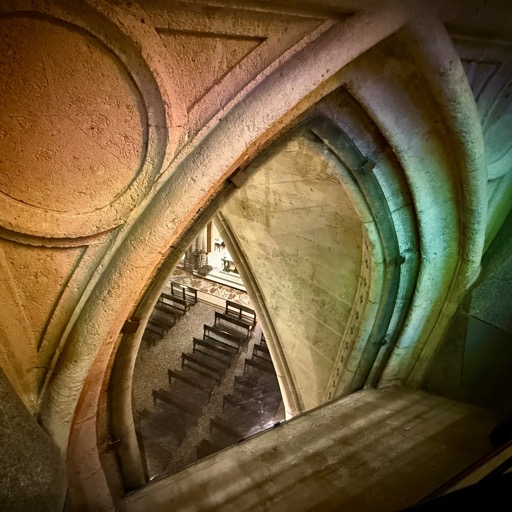


It is a massive organ that was being played while we were there. The acoustics were astounding.
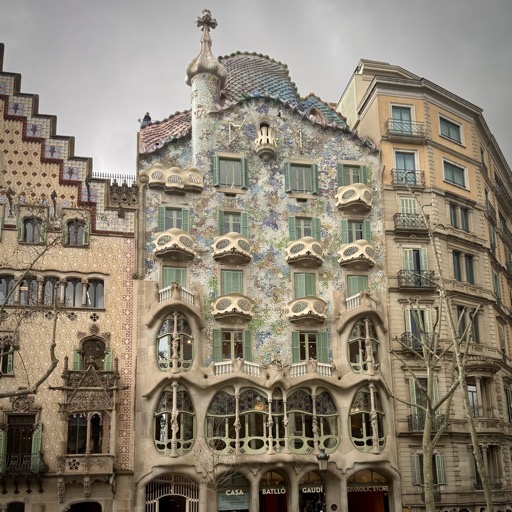
This house was commissioned to tell the story of St. George slaying the dragon. You can see the roof with the tiles as well as the balcony ‘skulls’. The chimney is the sword that he used.

At some point these Argentinian Parrots were released and they have now become an invasive pest.


Park Güell has its origins in an urban development project that was awarded to Antoni Gaudí by Eusebi Güell, a prominent Catalan industrialist whose plan was to build 61 houses for well-to-do families, along with a network of roads, viaducts and stairs to make it easier to get around the hilly terrain. Güell wanted to recreate the British residential parks and locate homes close to nature. Hence why he called it Park Güell.
Work began in 1900 and finished in 1914 with the construction of the pillared hall (hypostyle hall) and the bench.
The Park is organised around a central core of monuments: the staircase, the pillared hall and the square.
Work came to an end and in 1922, following the failure of the urban development project, Güell sold the Park to the City Council, which opened it to the city as a public park.
1969 – Declared a historical-artistic monument by the Spanish government
1984 – Declared World Heritage by UNESCO
1993 – Declared Cultural Asset of National Interest by Catalonia’s autonomous government.


Inside each if these columns is a pipe that funnels rain water from the catch basin above into the reservoir.


Part of the wavey bench that surrounds the central space. He said that if the bench is straight people ignore each other, but on a wavey bench you are forced into groups facing each other.


To mis-quote Gaudi himself:
“Beauty is not a question of money, beauty is a statement of art.”

Oir final show on the ship was a Catalan Rumba show. It was high energy and full of fun.