Today was an early morning private tour of the Vatican Museums, the Sistine Chapel and St. Peter’s Basilica.
We saw only ‘highlights’ on our three hour tour. It is massive and overwhelming and the art inside is rare and beautiful. And there is so much!
They were doing restoration of the Last Judgement wall in the Sistine Chapel but the famous ceiling was there in all its splendor.
St. Peter’s Basilica is by far the largest church we have ever been in. It is so much bigger than anything we have ever seen in a photo. To walk into that space makes you feel small, and exalted at the same time.

The original entrance of the Varican Museums had a statue of Michelangelo and Rafael above the door.

It is the second busiest museum in the world with roughly 20,000 visitors per day. Early morning is the best time to be able to see anything.




This group, found on the Esquiline in Rome in 1506, was immediately identified as the Laocoön described by Pliny and created by the sculptors Agesandros, Athanodoros and Polydoros of Rhodes. The group depicts a famous scene from the mythical Trojan War. Laocoön, a priest of the god Apollo, was opposed to the wooden horse being drawn into Troy, but Athena and Poseidon, who favoured the Greeks, sent two monstrous serpents up from the sea to strangle Laocoön and his two sons to death in their coils. In a Roman interpretation of the story, the death of these innocents was essential since the escape of Aeneas was crucial to the founding of Rome itself. Clearly such an important sculpture did not escape the notice of Julius I (1503-1513), who immediately bought the work and made it the pivotal work in the ideological concept of the Statue Court in Belvedere.
When the sculpture was found, some pieces were missing, including the right arm of the ancient priest. Artists such as Baccio Bandinelli and Giovanni Montorsoli were involved in the restoration work which resulted in Laocoön extending his arm out as though attempting to free himself from the serpent’s coils. The original arm was fortuitously found in an antiques shop in Rome in 1905 by the scholar Ludwig Pollak. This fragment, with the right arm bent as though attempting to ward off the serpent’s fatal bite, was not reattached until 1958. The chronology of this marble masterpiece is still subject to debate, although there is a degree of consensus on a date of around 40-30 BC.


So many of the floors are ancient Roman mosaics that were moved tile by tile.


This is the room that contains the original documents that decreed the virgin birth.


The Sistine Chapel is a chapel in the Apostolic Palace, the pope’s official residence in Vatican City. Originally known as the Cappella Magna (‘Great Chapel’), it takes its name from Pope Sixtus IV, who had it built between 1473 and 1481. Since that time, it has served as a place of both religious and functionary papal activity. Today, it is the site of the papal conclave, the process by which a new pope is selected. The chapel’s fame lies mainly in the frescoes that decorate its interior, most particularly the Sistine Chapel ceiling and The Last Judgment, both by Michelangelo.
Now sing with me:
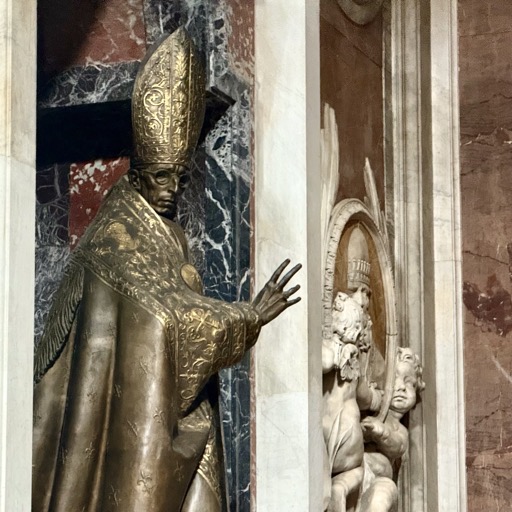
Reaching out… Touching me, touching you…
PS. Photography is strictly forbidden inside the Sistine Chapel.


Michelangelo’s aesthetic interpretation of the Pietà is unprecedented in Italian sculpture because it balances early forms of naturalism with the Renaissance ideals of classical beauty.
The statue was originally commissioned by a French cardinal, Jean Bilhères de Lagraulas, then French ambassador in Rome. The sculpture was made, probably as an altarpiece, for the cardinal’s funeral chapel in Old St Peter’s. When this was demolished it was preserved, and later took its current location, the first chapel on the north side after the entrance of the new basilica, in the 18th century. It is the only piece Michelangelo ever signed.