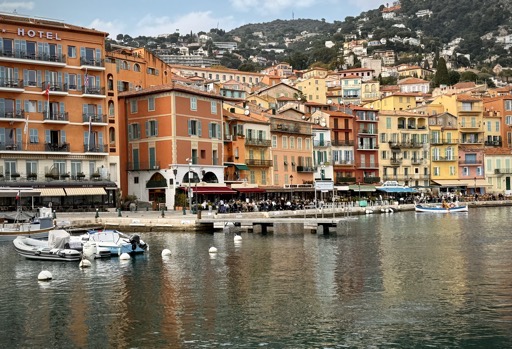
We docked on the famous Cote d’Azur near the small town of Villefrance-sur-Mer.
We tendered from the ship to the port and then went off to explore the principality of Monaco.
This whole area is so beautiful with charming coves and bays all along the coast. Of course, this area has been popular with the rich and famous for hundreds of years, so there is a cascade of mansions and palaces along the mountainsides that makes for a very scenic trip.


Our first stop in Monaco, the Musée Oceanographique de Monaco which was inaugurated in 1910 by Prince Albert 1. The famous deep see explorer, Jacques-Yves Cousteau, was director of the museum for more than 30 years.

The original deep sea submarine of Jacques-Yves Cousteau is on display outside the museum.


Cathedral of Our Lady Immaculate, also know as the Cathedral of Monaco, is a Romanesque-Byzantine Catholic church that contains the remains of many members of Monaco’s ruling family.


The Prince was in residence so there was a lot of other security as well as the guards.

A view of the racetrack of Monaco which is now being prepared for a visit from the pope. The side of the hill behind is the district of Monte Carlo.


Nice, capital of the Alpes-Maritimes department on the French Riviera, sits on the pebbly shores of the Baie des Anges. Founded by the Greeks and later a retreat for 19th-century European elite, the city has also long attracted artists. Former resident Henri Matisse is honored with a career-spanning collection of paintings at Musée Matisse. Musée Marc Chagall features some of its namesake’s major religious works


The Rue Obscure (Dark Street) in Villefranche-sur-Mer is a 430-foot long 13th-century covered passageway in the Old Town. Originally a defensive, open-air walkway for soldiers, it was later covered by houses, creating a dark, tunnel-like alleyway..

A copy of the painting by Jean Cocteau at the entrance to the Rue Obscure.