For his birthday today Gavin had a full day planned, which involved a lot of eating. A lot!
First in the agenda was a food tour where we were to ‘taste’ food from each of the three major cultures in Singapore.
We did not expect ‘taste’ to mean eating a full on meal of mutliple dishes every 90 minutes.
The tour started in the Malay section where we had the traditional tea and two versions of breakfast.
A short walking tour through the area lead to a subway ride to the Indian section.
Here we had four different Indian courses in the Tekka Hawkers Market.
Next stop was the famous Michelin starred hawker stall in China Town. They did arrange our meal ahead of time, since the line to get food from it was about a 45 minute wait in line.
By now we were stuffed, and it was not even lunch time yet.
The tour ended in front of the Buddhist Temple and our guide highly recommended a tour of the museum upstairs, as well as seeing the Buddha’s Tooth Relic.
One can probably figure it out from the name that the drink ‘Singapore Sling’ was invented here in Singapore. We headed off to the Long Bar in the Raffles Hotel that claimed they invented it.
It was such a good idea, that every other tourist in town also had the same plan. Standing in a long line in this heat for a drink suddenly lost its appeal.
Dinner was at a highly recommended restaurant where the chef took his family’s handed-down recipes and fused them wiith his formal European training to create some unique dishes.
And they were.
It was a great day of friends celebrating with a lot of eating.


Masjid Sultan, also known as Sultan Mosque, is an important focal point for Muslims in Singapore and the most prominent landmark in Kampong Glam. Every year, during the fasting month of Ramadan, Muslims gather in the vicinity of the mosque to await the prayer call to break their fast.
Though the current building was constructed in the late 1920s, Masjid Sultan has a history that goes back to the early part of the 19th century.
In 1819, Sir Stamford Raffles (1781-1826) signed a treaty with Sultan Hussein (1776-1835) and Temenggong Abdul Rahman (d. 1825) allowing the British East India Company (EIC) to establish a trading post in Singapore.
In 1823, the Sultan wanted a mosque near his residence at Kampong Glam. Raffles made provision for the mosque to be built near the istana and allocated funds towards the construction.
The mosque, a brick structure with a three-tier tiled roof, was constructed between 1824 and 1826, and served the community for a century.
In 1879, Sultan Alauddin Alam Shah (d. 1891), also known as Tunku Alam, who was Sultan Hussein’s grandson, and a Tunku Aleema gave more land to the mosque.
By the early 1900s, the mosque had become inadequate for the Muslim population. In January 1924, it was decided that the mosque would be demolished and rebuilt. The present building, commissioned in 1924, was designed by Irish architect Denis Santry of Swan and MacLaren in the Indo-Saracenic style, with distinctive domes and minarets.
The mosque was built in phases over a few years so that funds could be raised, and devotees could continue performing their prayers in the mosque.
The cost of the rebuilding was funded with donations from the Muslim community. In addition to monetary contributions, the community also donated glass bottles which were incorporated into the base of the dome.
When war broke out in Malaya in 1941, people of different ethnicities and creeds sought shelter at the mosque and one of its minarets served as an observation post to look out for enemy aircraft.
Masjid Sultan was gazetted as a national monument in 1975. The annex building, designed in a similar style to the mosque, was officially opened in 1993.


Tekka Market, also known as Kandang Kerbau Market, was built in 1915 and became a well-known marketplace for fresh cut meat. The name, Kandang Kerbau, made reference to the surrounding cattle trade and means “buffalo enclosure” in Malay. The Chinese called it tek kah because of the wild bamboo found in the area. The original market was located across Serangoon Road, opposite the present site. Tekka Market was popular amongst all communities and known as the “people’s market”. It gained a reputation for its varied and reasonably priced fresh vegetables, meat and seafood.
During the redevelopment of the Serangoon area in the early 1980s, the market was demolished and most stallholders were relocated to the present site, which was renamed as Zhujiao Market, a Chinese transliteration of “Tekka”. In 2000, the market was renamed Tekka Centre to better reflect the history of the place after public feedback that Zhujiao bore little resemblance to its former name.


The famous Michelin starred hawker market chicken.


“Remembering Our Past, Celebrating Our Future!”
By : Zhenghua Primary School
Our pioneer, the Samsui women, went through much toil and sweat in the building industry. These buildings, still a part of Singapore’s History, have withstood the test of times and bear witness to their resilience and efforts. To acknowledge the tremendous sacrifices of our Samsui women, students at Zhenghua Primary put together these artworks in memory of them. It is their way of paying tribute to the Samsui women for their immense contributions towards our nation building. It is a privilege for the students to embark on this meaningful journey of placing history onto canvas in their honour.


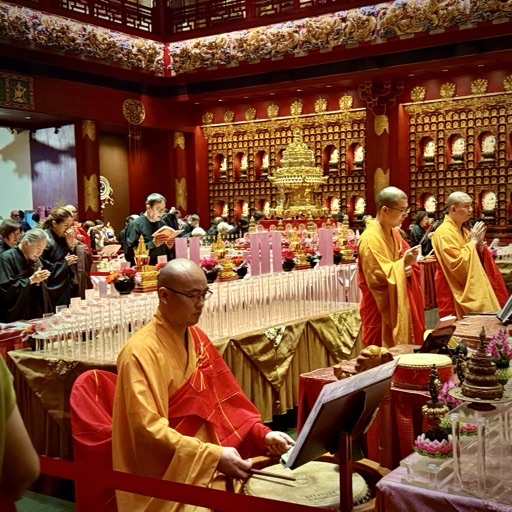


The Buddhas of the World Museum serves as a one-stop portal for visitors worldwide to appreciate the life story of Buddha Shakyamuni, to understand the meaning of His key teachings (Dharn as well as to introduce the future Buddha, Maitreya, through the artworks and artefacts.

The Vairocana Buddha Prayer Wheel is installed inside Ten Thousand Buddhas Pavilion.
It is the largest cloisonné Buddha Prayer Wheel in the world. “Revolving scriptures” originated from “turning the pitaka”. “Turning” a Sutra is different from “reading pitaka” which virtually meant reading the Sutras everyday without missing a single word. “Turning pitaka” is just reading a few lines at the start, middle and end portions of the Sutras.
Cylindrical in shape, it is a religious artefact commonly used by Chinese Buddhists. The rim is embossed with esoteric Vairocana Mantra. A piece of scripture is placed inside. Every turn of the wheel represents a single recital of the scripture and mantra. The wheel is a convenient way to recite the sutra.

Visitors to Raffles Hotel Singapore were a cosmopolitan lot, with many being energetic globe-trotters. In the early 1900s, when rail and road travel improved, palm oil plantation owners from Malaya would retreat to Singapore during the weekends, initiating a ritual known fondly as “Planter’s Weekend”.
Travellers also included the well-heeled on round-the-world cruises, such as European adventurers of various colonies, French Indochina and Hong Kong as well as various merchants on their way to China and Japan.


People will tell you that the best Eurasian food in Singapore is found not in Singapore but in homes, cooked from recipes handed down through the generations.
Here at Quentin’s, we introduce the Eurasian past and future cuisine, passed down from generations and to carry the tradition and introduction of new creations to future generations!
“Skinny Chef” Quentin learned the art of Eurasian Cooking from his Grandparents. He has taken the bold step of setting up a Eurasian Restaurant knowing full that Eurasian Family cooks will be his harshest critics.