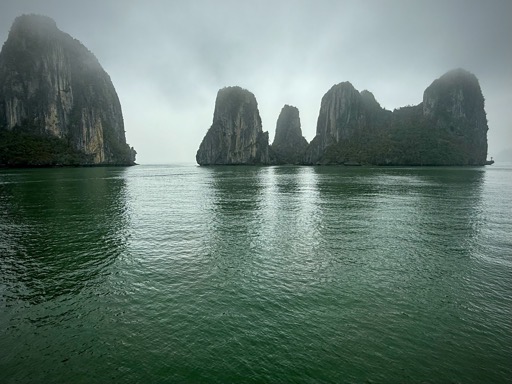
It was a foggy morning in Halong Bay, which made the excursion to see this UNESCO area with one thousand and sixty eight islands so exotic and even more interesting then mere postcard photos.
You could even imagine at some point an old pirate ship from centuries ago appearing in the fog from behind an island.
Our first stop was Dau Go island where, according to the description, we were told there were 450+ steps. Everybody imagined a steep staircase of rock going straight up to a tiny cave on top with a buddha inside.
The reality was so much better. Steps were part of an easy walkway and the cave(s) were massive and beautiful.
Back on our ‘junk’ – not a comment on the state of the vehicle we were in, albeit appropriate, but rather a new generation of old Asian vessels – we headed of to see the island that is also on one of their bank notes.
Islands keep appearing and disappearing from the fog. So magical.
Last ones we headed to were ‘The Fighting Chickens’. Quite the ‘junk’ traffic to get there, but we were able to see it up front.
A truly wonderful day.


Dau Go Cave is located in the Dau Go Island, dubbed as the “Cave of Wonders”.
The cave is an old phreatic underground cave formed between781,000 and 11,700 years ago. It is around 5,000 square meters in size and is separated into three chambers with a broad open structure outside and a narrowing inside. It possesses an antique and unspoiled beauty.

Each chamber of the cave is a magnificent work of nature formed by distinct speleothem. The first chamber is large, beautiful, and ancient with moss; the second chamber is strong, brilliant, and gorgeous, like massive monuments; and the third chamber is rustic and mysterious.

Dau Go boasts diverse environments, including mangrove forest and cave ecosystem. In 1918, King Khai Dinh (Nguyen Dynasty) visited the cave and had a stele erected at the cave entrance to mark the trip, praising the beauty of Ha Long Bay and Dau Go Cave. In 1957, President Ho Chi Minh visited Dau Go Cave and said: “No visitor can convey the beauty of its scenery, so everybody should visit the cave to enjoy its beauty themselves”.


Ha Long Bay was inscribed in the UNESCO List as a World Heritage Site in 1994 with the criterion of aesthetic value and expanded geological and geomorphological criterion in 2000. In 2009, the Vietnamese government designated Ha Long Bay as a special national monument. In 2012, Ha Long Bay was voted as one of the seven new natural wonders of the world. In 2023, the World Heritage Committee approved expanding the boundary of Ha Long Bay World Heritage Site to include Cat Ba Archipelago (Hai Phong city).

Ha Long Bay – Cat Ba Archipelago is a remarkable sculpture of nature, with thousands of large and small limestone islands rising from the pure blue water in a variety of shapes and patterns, producing a pristine and picturesque landscape. This is the most prominent and largest model of karst terrain invaded by the sea and one of the most important areas in the world for karst terrain fengling (separated peaks) and fengcong (clusters of limestone pyramids lying next to each other).

The Ha Long Bay – Cat Ba Archipelago boasts a diverse range of ecosystems, including tropical rainforest, cave, mangrove forest, tidal flat, coral reef, soft bottom, and Tung – Ang.

Ha Long Bay – Cat Ba Archipelago is also home to the ancient Viet people with three cultures: Soi Nhu, Cai Beo, and Ha Long; where the history of Vietnamese people creating and defending their country is imprinted; and where the unique culture of the fishing community living on the sea has been preserved.

