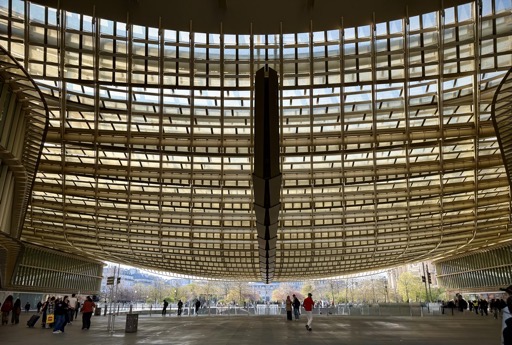
We left the ship early morning and went directly to the train station.
The trip through the countryside was fast and fun, except maybe for the included lunch. The wine was good, though.
We arrived in Madrid and immediately went down to the jam-packed metro to make it to the location of our hotel.
It is a great hotel and our room has a balcony overlook the Grand Via. It is like getting a hotel in Times Square overlooking Broadway.
After strolling around experiencing the sights and sounds of the city, we headed off to our Flamenco Dinner experience. And what an experience that was!
The drama and passion and energy of the performance is impossible to capture with a photo.
The city at night was buzzing with energy and we strolled around for quite a while absorbing and walking off all that food.
Buenas noches, Madrid!
Good morning and goodbye, Barcelona.We got up to speeds of 276km/hIn Madrid.Our great little hotel.We have a balcony! The view of the Grand Via from outside our room.Quieter side streets.
The defining essence of Ancien Régime Madrid, the cause of its greatest glories and worst misfortunes, can be traced back to 1561, when a humble Castilian town became the permanent royal seat of one of Europe’s first absolute monarchies.
Madrid thus became the capital of an empire which, in addition to the kingdoms of Iberia, encompassed Italy and the Spanish Netherlands as well as the vast and variegated overseas dominions of the Indies
View of Madrid from our rooftop bar.Our first tapas in Spain!Flamenco dinnerOur table was against the stage.Passionate and demanding.The hardest working performer in the show!Olè!
We are still surprised how many actual bookstores there still are in Europe.
We started with a morning wandering through the still quiet streets of Madrid before we met our very informative guide for our food tour.
During the food tour not only did we taste delicious and iconic dishes, we also learned a lot about the city itself.
After the tour we thought it prudent to waddle around a bit to get some of all that deliciousness processed, since we had a great dinner planned.
We walked across the much busier city now to the quiet botanical gardens next to the Prado Art Museum.
On our way back to the hotel we noticed the sidewalks are getting more and more packed with people. Little did we know that it was part of the nearly a quarter of a million people waiting for one of the largest St. Patrick’s Day celebrations in Europe.
Our hotel, with balcony, overlooks the Gran Via which is the main parade route. Once upstairs we poured some wine and watched the parade from up high, like royalty.
Early morning Madrid
The Royal Palace of Madrid is the official residence of the Spanish royal family and is used primarily for state ceremonies. With over 135,000 m² and 3,418 rooms, the Royal Palace of Madrid is the largest royal palace in Europe and one of the largest in the world.
THE ORIGIN OF THE WORD MAJRIT
The ancient city of Majrit was founded on land under which many underground aquifers flowed, by a stream that ran along what is now Calle de Segovia, making this a privileged location. In fact, the word Majrit is a hybrid between the Arabic word, “Majra”, which means waterway of course, and the Romance suffix “it’s which indicates abundance; hence the meaning is a place of abundant waters”. Indeed, Majrit was traversed by numerous underground Water channels or conduits, known as qanats, which supplied the population with water and also irrigated the croplands.
The facade is painted!
The Plaza Mayor is the principal public square in the heart of Madrid, the capital of Spain and it was once the centre of Old Madrid.
The Mercato de San Miguel is a stunningly beautiful market in the heart of Madrid.
It now consists of mostly tapas stalls with unusual bites and little bar counters.
TapasMeat to go for a snack while you walk.
A store where people write their wishes and stick them to a wall. There were many thousands of notes.
Our first stop on the food tour.
Our first sample was Iberian ham, which comes in three qualities, diced tomatoes in oil for the bread, and a glass of Cava.
We got to try and cut the ham ourselves. It looks a lot easier than it is!
The oldest door in the city still dates from the time of the Moors.
Next stop.
Our drink was a local drink similar to sangria but with no fruit called Tindo de Verano.
Fried mushrooms with garlic and chorizo.
Grilled padron peppers.
The oldest continuously operating restaurant in the world. They even had the certificate from Guiness that says that!
Next stop looks a little crazy.
The mass of people trying to order. The lines went around the block.
This is what all those people wanted. The most amazing calamari sandwich.
The location where the iconic dish Patas Bravas was invented.
La Casa de Abuelo is next on the list.
It is a little loud and crazy in here!
The famous garlic shrimp. We had a dry vermouth with lemon as our drink.
Time for something sweet to end the tour.
The entrance to the store has a view to a crypt. Very disconcerting.
Truffles and little pieces of chocolate called ‘Cat’s Tongue’
Drinking chocolate.
Stopped for a drink on the walk.
The Royal Botanical Garden (RJB) is a privileged historical space located in the heart of Madrid. It was inaugurated in its current location in 1774, during the reign of Charles III.
It is part of the Spanish National Research Council (CSIC), Ministry of Science and Innovation, and is recognized as an Artistic Garden and National Monument.
From February 13th to May 17th 2026, the work of Dutch artist and activist Claudy Jongstra and renowned Spanish fashion designer Marcos Luengo, alongside digital artist Ivan Puñal will be presented in collaboration with Villa del Arte Galleries at the emblematic Real Jardín Botánico de Madrid.
The exhibition, Día y Noche. Ritmos del alma connects the art of Luengo and Jongstra with the world of plants in the botanical garden and will follow the rhythm of day and night. The cycle of life is all around us omnipresent in different shapes and forms; we can experience it in the ebb and flow of the seasons, or the ever-returning night and day. Plants, like all life on earth, are affected and influenced by this cycle of dark and light, and their sap flows from roots to crown following this rhythm. In a world that increasingly values efficiency and economic gain, there is diminishing space and appreciation for the time, knowledge and intuition it takes to follow and work with this rhythm.
For as long as we can remember plants have been used by mankind to produce the most beautiful colours, from the lightest and brightest yellows, greens and pinks to the deepest, darkest blues and blacks. In her work, Jongstra celebrates the whole colourful spectrum of these plants and their dyes, many of which can be found in the Real Jardín Botánico. But her art is not just a celebration of colour, it also addresses urgent themes such as ecology, the loss of biodiversity, and creates awareness about how we can revitalize rural communities and preserve natural heritage, whilst questioning issues such as waste wool and the impact on the environment.
Watching the St. Patricks day parade from our balcony, once we were able to elbow our way through the quarter of a million people attending to make it to our hotel.
LANGOSTINO CON MAYONESA CALIENTE King prawn – garlic tom yum stir fry. Thai suquet – “de La Vera” paprika – coconut milk. Tempered “quisquillas” Crispy baby shrimp tortilla. Sautéed chili peppers oil – blue belly prawns. Steamed. Rolled Har Gau
MOLLETE AL VAPOR DE PINTADA Thai curry stew – guajillo chili – bergamot and mandarin-butter. Steamed bao. Knocked offf fermentation..
CENTOLLO WILLY FOG: DE DONOSTI A SINGAPORE Stewed spider crab “a la donostiarra” – sheep’s butter hollandaise gratinated with txakoli – Pimentón de la Vera. Steamed. Crystal.
PINK PUNK KAKIGORI Bergamot and lychee – whipped mascarpone cream, oolong tea and vanilla – sour cherry coulis – fairground marshmallows. Shaved ice.
PASTEL FLUIDO CHOCO BLANCO Y YEMAS Tom kha – cayenne – galangal.
We ended the night with drinks on the hotel’s rooftop bar.
Of course this then called for a rest period on the square watching people, with a glass of wine.
The train ride even included lunch and we made it to Valencia relaxing at high speed.
Valencia was loud and crowded. The city is in the middle of the Fallas festival and on Sunday evening is the official ‘raising of the fallas’ as well as the official opening.
Nearly every square in the city had a party going on. The kids throwing loud firecrackers everywhere made it all the more chaotic and loud.
It was great fun to be in it.
We stared in wonder at the amazing art of the Fallas.
Tomorrow we have a tour that will teach us all anout the festival and the Fallas themselves. Can’t wait!
Sunny breakfast roomJardines de Sabatini
The Sabatini Gardens are part of the Royal Palace in Madrid, Spain, and were opened to the public by King Juan Carlos I in 1978. They honour the name of Francesco Sabatini (1722–1797), an 18th-century Italian architect who designed the royal stables of the palace, which used to be located at the site, as well as other works at the palace.
Campo de Moro
Campo del Moro was designed in the 19th century under the rule of Queen Maria Cristina, thus creating a garden with a clear English style and following the romanticism of nature. One of the difficulties presented by the enormous garden was the difference in height with the Royal Palace, which is why it was not designed before. However, today it is one of the most beautiful landscapes of the Spanish capital.
Eating lunch as the Spanish countryside blurs by at 300km/hWelcome to ValenciaThe largest one is in the city square and is titled ‘Hope’
Our day started with a nice early morning walk through the quiet streets with only the occasional firecracker going off. Last night was such a big party night in the city that there is no doubt people are sleeping in.
We learned the most fascinating facts during our tour and saw a selection of the more than three hundred Fallas. More than fascinating.
We spent the rest of the day in the city enjoying the atmosphere and watching people.
At some point, sitting in a narrow street near a corner, we regularly saw the dressed ladies followed by a band walk by and disappear again, just the echoes of the music remaining. It was such a unique experience.
The Fallas festival is a spectacular 5-day event in Valencia, Spain (March 15-19), celebrating Saint Joseph and the arrival of spring with massive satirical papier-mâché monuments called fallas. Neighborhoods display these intricate, costly structures before burning them in huge bonfires known as La Cremà on March 19th, symbolizing renewal.
It is a UNESCO Intangible Cultural Heritage of Humanity celebration that brings together community pride, artistry, and political satire, allowing for a symbolic cleansing through fire, where old energy is released to welcome spring.
The tradition dates back to the Middle Ages, when local carpenters burned old scraps of wood and debris to mark the end of winter on the feast day of their patron saint, Saint Joseph (March 19).
La Plantà (March 15-16): The act of erecting the 700+ massive fallas(monuments) and smaller ninots (puppets) overnight. Mascletà (March 1-19, 2 PM): A daily, loud, rhythmic firecracker exhibition in the Plaza del Ayuntamiento. La Ofrenda (March 17-18): An emotional flower offering to the Virgen de los Desamparados (Our Lady of the Forsaken), where a giant wooden statue of the Virgin is filled with floral bouquets by thousands of falleros. La Cremà (March 19): The grand finale, where the fallas are set on fire around midnight, starting with the children’s monuments.
Only one small piece of a falla, the ninot indultat (chosen by public vote), is saved from the fire, becoming a permanent exhibit in the city’s Fallas Museum.
The streets are filled with non-stop music, marching bands, food festivals featuring churros and buñuelos, and fireworks.
There was a lot of partying late into the night. Early morning on the way to our tour we saw a lot of people moving slow and wearing sunglasses.
The Central Market looks like a bright and airy cathedral.
Setting up the daily fireworks, which are just noise makers with colored dust. They are really really REALLY loud.
There is still a bullring and it is still being used for that.
The origin of Fallas as told by the guide.
Originally, the farm workers build stands with lanterns on for light during the winter. At the equinox they would then burn the lantern to symbolize going into spring and the longer (and brighter) days.
Later on they would add other burnable materials for a bigger fire.
At some point they started to get creative with it and make the piles into figures, mostly satirical.
The modern Fallas are all still very themed, and invariably includes satirical elements.
They still get burned!
Every area usually creates two Fallas, the big one and a little one for the children. The themes for the child Fallas are always educational.
The detail they can get with only paper mache and wood is incredible.
Some of these are up to 24 meters tall and can cost up to €600,000. And everything gets burned to ashes on the 19th of March.
There are also more ‘avant-garde’ and experimental Fallas. This one was about gentrification and on the last day, before burning, it will be filled with little blue people that symbolize out-of-towners.
A few of them even move.
These dresses are part of the tradition. Each one is unique.
A random mini-parade.
A blacksmith shop in the middle of town.
Starting tomorrow, on the 17th of March, there will be a two-day parade with everybody dressed up. The costumed people from each neighborhood will start at their Fallas and followed by a band, walk to this square and place flowers on this statue.
The design that the flowers make is different every year and kept a secret.
More and more people in the streets every day.
Having a snack in a little street cafe and suddenly there’s music.
We started with a three mile walk down the beautiful Turia Park.
This is the bed of a diverted river that flowed through the city. After years of not being able to decide what to do with all that land, the city noticed that people used it as a park. It was then developed into this beautiful green ribbon that ‘flows’ through the city.
Our goal was to go see the architecture of Calatrava in the City of Arts and Sciences.
The soaring buildings were indeed breathtaking and there is no photo that can give you a sense of the soaring spaces. Truly elevating.
This setting has also been used in a lot of futuristic shows and movies.
Breakfast!When you bought your monument from Ikea but lost the instructions.
Gulliver Park is a playground where there is a giant statue of Gulliver. When kids play on him you see them as Lulliputans. Adorable.
Even the interiors are soaring and breathtaking.
Santiago Calatrava was born July 28, 1951, in Valencia, Spain and is a renowned architect, structural engineer, and sculptor known for futuristic, skeletal designs and soaring, white concrete structures.
We walked back through the town since we wanted to see the ‘Placing of the Flowers’
It is quite the event. The parade streets are packed with people watching and cheering.
The neighborhoods show up in full costume, from newborns to great-grandparents and proudly walk, followed by their own band, into the square and hand the flowers over to the workers on the statue.
They start filling in the pattern from the top. We will not be in town long enough to see the final design.
The streets are filled with beautiful costumes either waiting for their turn to add their flowers, or more relaxed people that are done with their parade.
It is like the whole town is filled to the brim with costumes and colors.
And firecrackers.
Valencia Train Station
It is St. Patrick’s Day after all, so we had to stop at one of the Irish pubs for a Guiness.
The final destination of the parade.Filling in the flowers from the top.A random children’s Fallas being all judgy.
We left Valencia early morning and took the train to Barcelona.
We made it in time to walk around a little bit before we started our evening food tour of Barcelona.
Like the previous one, it was a great mix of food and drinks, history and the history of the foods and restaurants. We had a great time.
Valencia, in my dreams it always seems I hear you softly call to me Valencia, where the orange trees forever Send the breeze beside the sea Valencia, in my arms I hold your charms Beneath the blossoms high above … – Traditional Song
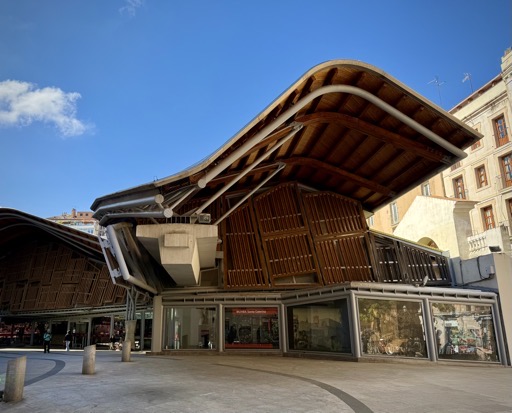
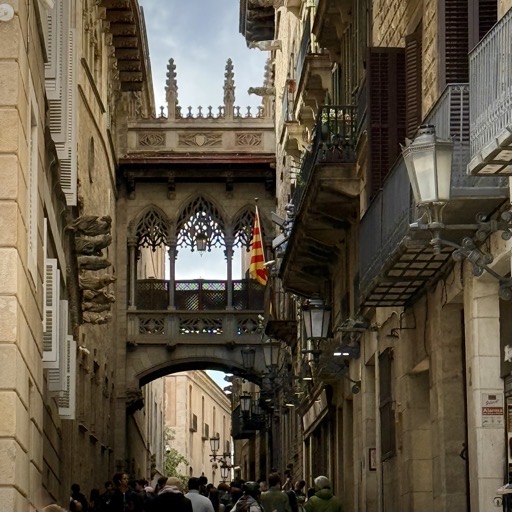
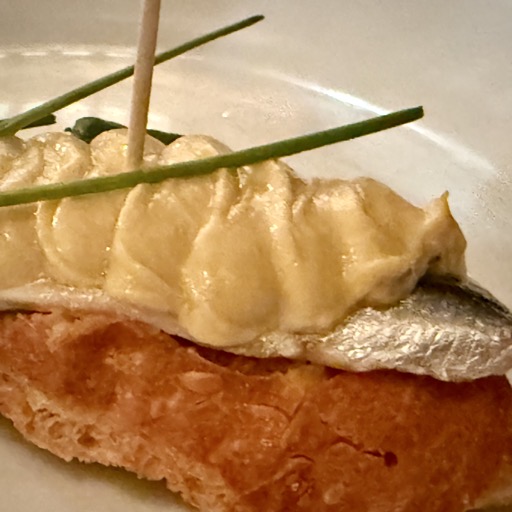
Any civilized breakfast on a train should include Cava. Barcelona Gothic Quarter. One of the many local markets in the city.Street Picasso?Roman ruins in the old town. First tasting had two options, with wine. Mushrooms with Ibarian Ham.Fried eggplant with honey.An inbetween course tasting of nuts before the second stop.Pinchos with Anchovies – two versions.
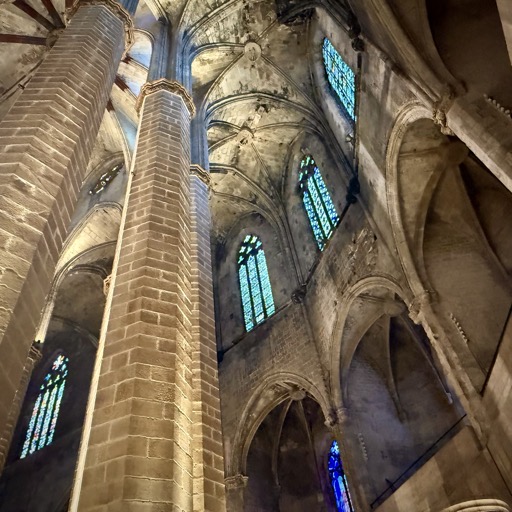
The church dedicated to brothels and their workers was built with community money since the ‘Church’ did not want to pay for that kind of church.
When it burned down the community was not able to raise all the funds to rebuild it, so the Barcelona Football (Soccer) club paid for it.
Inside the church there is a stained glass window with their flag as a way to show their appreciation.
La Bomba de la Barcelonetta. One of the two Paellas we had. The other was seafood.Dessert was Buñuelos. Street scenes walking back after all the food.
We ventured out to Montserrat today on a tour that also included a lunch and a wine tasting.
Montserrat is beautiful and the views from up there are stunning. We did not have enough time do some of the hikes further up, but the panoramas are still spectacular.
This was followed by a three course lunch at a winery that has been operational since the 10th century.
The land of the farm was originally awarded by the king to a potter as a reward. You know what else clay soil is good for besides pottery? Wine!
Today they only do fully organic wines and it was a really interesting tasting.
Of course we were going out to dinner after all of that. We are professionals by now.
At LOKAL we had a selection of tapas that included some really good steak, and interesting oxtail wheels.
Good morning, Barcelona!
Montserrat Monastery is a stunning 11th-century Benedictine abbey perched on a jagged mountain range 59 km northwest of Barcelona, Spain, known as a major pilgrimage site and home to the revered 12th-century Black Madonna statue.
They told us repeatedly that the first bishop of Monserrat was NOT an extraterrestrial. Sure.
The front of the church.The chapel inside.The Black Madonna that the pilgrims travel to touch.Candle grotto.
They have a little produce market with products from the surrounding area. We got a ‘cone of cheese.’
Entry to the art museum under the plaza.
There range of artwork was quite impressive with Picasso, Dali, Monet, Sargent, Miro and a lot of other famous artists represented.
This Caravaggio from 1605, Penitent Saint Jerome, is their most famous.
The exit of the museum is art about people looking at the art.One last view of Catalania from the Serrated Mountains.
Oller del Mas was established in 946. We are having a (late) lunch with wine, followed by a wine tasting.
The first of the three courses was a really interesting winter vegetable soup.
All the wines on the farm are organic.A view of Montserrat (The Serrated Mountains) from the tower.Flamed steak at Lokal.Oxtail wheels.Good night, Barcelona, we’ll be back.
To paraphrase Montserrat Caballè and Freddy Mercury’s duet:
I had this perfect dream This dream was me and you I want all the world to see A miracle sensation My guide and inspiration Now my dream is slowly coming true
The wind is a gentle breeze The bells are ringing out They’re calling us together Guiding us forever Wish my dream would never go away
It was the first time that we met Barcelona how can I forget The moment that I stepped into the city You took my breath away And if God willing We will meet again someday
We traveled to Paris on the high-speed TGV from Barcelona and best of all, there were dogs on the train.
After checking in to our hotel, we walked around for a while, bought some fancy chocolate and had a glass of wine before dinner.
Dinner was the quintessential cherry-on-top of a great culinary birthday journey.
We were able to get last minute reservations on a front window table in the restaurant in the Eiffel Tower.
Neither one of us has ever been up the tower before, and to go up and then have an amazing dinner at the best table in the restaurant was very special. The view was spectacular.
After dinner we walked up to the Trocadero to see the hourly flickering of the tower.
It was a late and fantastic night.
High speed train through the French countryside.
Welcome to Paris.Fun view from the hotel room. The courtyard was quiet.Our favorite street.Last bougie chocolate buy to be able to pack it all.Sneakies before dinner.She is such a beauty at night.
Up we go!
Our restaurant for tonight.The view from our window table.The ‘second floor’ was surpisingly empty.
The last time we were in Paris this was covered in volleyball fields. (See the 2024 Some Summer Games journal)
Best view of the tower with perfect timing.
The way in to the Metro is so charming and French.The way out, not so much.