The ‘Miracle Square’ in Pisa was definitely worth experiencing.
The idea was the four steps of religious life: baptism, church, cemetery (burial) and the ‘stairway to heaven’.
However, since they are all so close to the water there is nothing really to support the foundations. The tower, the most concentrated mass on the smallest space, slanted first but all the other buildings are also all a little askew.
Good morning, Livorno!Umbrella Pines are everywhere.Walking into PisaOur first view through the city gate.
The Baptistery stands as one of the cardinal points of the idea of the square that was coming of age in Pisa in the XIl century; what was taking shape was a space that gave priority to the front view of the façade of the Cathedral, the axial character of which was now set off by such a meaningful building as the Baptistery, built along the same lines.
The reason for building such a fascinating as well as mysterious building was certainly the will to provide the Cathedral with a worthy addition: a Baptistery that, because of its location, size, materials and style, would be in tune with the impressive and typical building that existed before it. These might be the terms in which the holders of the local ecclesiastic and civil powers, who had expressly set up a board, the“Opera ecclesiae Sancti lohannis Baptiste”, had expressed their wishes to architect Deotisalvi, whose figure remains in the dark and can hardly be reconstructed as there are no written sources about him. The inscription “Deotisalvi magister huius operis”, “Deotisalvi is the author of this work”, found on a pillar of the Baptistery, claims authorship of the building.
According to the same source, in 1163 it was ordered that on the first day of the month every family of Pisa should pay one denaro to continue the building of the monument. This is evidence of the city’s contribution to the monument, as is also proven by the fact that the installation of the columns was organised and contributed to by the city neighbourhoods.
It is the largest Baptistery in Italy: 107.24 metres in circumference, while the wall at the bottom is two metres 63 cm wide, its height 54 metres 86 centimetres. The dome is covered in red tiles on the west side and in lead slabs on the east side.
The big cylinder is surrounded, like the Cathedral, by arcades on pillars and, like the Cathedral, it is made of white marble edged with grey. Inside, eight monolithic columns compete for height with the Cathedral, alternating with four pillars and outlining a central area that accommodates the octagonal baptismal font by Guido da Como (1246), with Nicola Pisano’s pulpit next to it (1260). A women’s gallery covered by a ringed vault looks out onto the central area with a series of large round arches. The covering is composed of a double dome, the inner one shaped like a dodecagonal truncated pyramid, the outer one in the shape of a hemispherical vault, with a smaller dome on top. It is precisely the unique architectural design of the covering that gives the Baptistery of Pisa exceptional acoustics. It can be heard every 30 minutes when the security guards perform a series of vocal intonations.
“The cathedral stands, secluded everywhere, in the vast, silent expanse of greenery enclosed by the crenellated walls of the Medieval town, that in such seclusion erected admirable monuments of its past life. In that isolation, the snow-white cathedral, visible from everywhere, looks as if it had been shaped and completed by a vast, consistent creative gesture”. (Pietro Toesca)
The importance attached by the people of Pisa to the building of the Cathedral can be read in the epigraphs that are still embedded on the façade: the tombstone of bishop Guido, who began building it, funded by the fabulous loot that the people of Pisa took from the pillage of Palermo in 1063, the tombstone of Buschetto, the first ingenious architect, in which the building is called “a temple of snow-white marble”, and the one that tells of the anti-Saracen battles of Reggio, Sardinia and Bona, in Africa.Founded in 1064 and consecrated with great pomp on September 26th 1118, the Cathedral was built in two stages, one by architect Buscheto, who created the original layout with the basilican body with four aisles and one nave, a transept with one nave and two aisles, and the dome on the cross vault, and one by Rainaldo, who extended the building and the façade.
The building was not finally completed until the last quar ter of the XII century, when Bonanno’s bronze leaves were placed on the central door. This famous masterpiece was lost, along with other important works of art, in the devastating fire of 1595.
Inside, the nave is edged by two rows of monolithic columns made of granite from the Isle of Elba, flanked by four aisles separated by smaller colonnades with large women’s galleries on top, covered by cross vaults and looking out onto the nave through some double-lancet and four-lancet windows.
The nave is covered by a wooden coffered ceiling that in the XVII century replaced the original exposed trusses.
Of the rich and sumptuous decoration prior to the fire, remain the mosaics on the apsidal conch – where Cimabue made the figure of Saint John the Evangelist (1302 ca.) – the pulpit (1302-1310) by Giovanni Pisano, the dismembered sepulchral monument to Emperor Henry VII (1315), which used to be at the centre of the apse, and important examples of painting and wooden inlay of the Renaissance period.
The Cemetery is the last monument on Piazza del Duomo, its long marble wall flanking the northern boundary and completing its shape. It was founded in 1277 to accommodate the Roman sarcophagi that until then were scattered all around the Cathedral and were reused to bury local noblemen. This is how one of the oldest Christian Medieval architectures for the devotion of the dead came into being.
During the fourteenth century, as the construction took shape, the inner walls were embellished by wonderful frescoes about Life and Death, created by the two great artists of the time, Francesco Traini and Bonamico Buffalmacco, who seem to stage the sermons declaimed in town by the Dominican Cavalca or the frightening views of Dante’s Comedy; reference to it is most evident in the Triumph of Death and in the Last Judgement painted by Buffalmacco, who is also known as the character of some of Boccaccio’s stories. The cycle of frescoes goes on well into the fourteenth century with the Stories of Pisan Saints by Andrea Bonaiuti, Antonio Veneziano and Spinello Aretino and the Stories of the Ancient Testament, started by Taddeo Gaddi and Piero di Puccio and finished in the mid-15th century by the Florentine Benozzo Gozzoli, along the northern wall.
Since the sixteenth century, the Cemetery has sheltered the sepulchres of the most prestigious lecturers of the local University and the members of the Medici family, who ruled over the city at that time and are also hinted at by the characters of the Biblical scenes frescoed on the shorter walls.
The monument was to become the Pantheon of local mem-ories: not only of the local people or families but also of the glorious classical and Medieval past of the city. The building began to be used as a museum, its walls engraved with Roman epigraphs and the sarcophagi relocated to the corridors, acting now as valuables documents of history and art.
The use of the building as a museum established itself in the early nineteenth century when the Cemetery became one of Europe’s first public museums. In the years in which Napoleon decreed that many works of art should be taken away from the churches and taken to France, Carlo Lasinio, appointed Curator of the Cemetery by Maria Luisa, Queen of Etruria, collected amidst its frescoed walls the sculptures and paintings that were in the suppressed churches and convents of the city. Other works came from the Cathedral and the Baptistery, along with remains from the local archaeological sites and the antiques markets. In the meantime, commemorative and funerary monuments dedicated to the city notables continued to be built in the corridors that were renamed galleries.
Apart from its extremely famous inclination that really seems to defy the laws of statics, the Tower of the Cathedral is a very unusual building and one of a kind, because of the high historical and artistic value of its forms and because of its peculiar location, within that vast and equally unique area that is the Piazza dei Miracoli. The building is located far from the Cathedral, between the apsidal area and the southeastern section of the transept of the Cathedral. This is an unusual location – usually, a tower would be erected near the façade or along one side of the church – although this is not the only case, as it can be found in other complexes in town and in other Italian buildings. The current building, the result of a time-consuming construction work that was restored several times over the centuries, mostly to reduce the risk that it might collapse as a consequence of its remarkable inclination, is composed of a cylindrical stone body surrounded by open galleries with arcades and pillars resting on a bottom shaft, with the belfry on top. The central body is composed of a hollow cylinder with an outer facing of shaped pillars in white and grey San Giuliano limestone, an interior facing, also made of textured verrucana stone, and a ring-shaped stone area in between. This stone area accommodates a winding staircase with 293 steps leading up to the sixth open gallery, where the inner shaft is closed by a vault with a central hole to let light in, providing access to the belfry on top and, in the lower mezzanine floors, to the open galleries. The six open galleries resting on the bottom shafts, with this one and the belfry, divide the tower into eight segments that are called orders. The lower one is enriched by a round of blind arcades placed on half columns that include, under the arcade, a diamond-shaped compass inlaid with polychrome marble, with a raised rosette in the middle. The solid walls interrupted by the openings of some narrow single-lancet windows and, westwards, by the only entrance door: a rectangular area framed by a lintel. Above the lintel, a crescent-shaped arch with an inlaid archivolt rests on two capitals as a continuation of the jambs, forming a shrine containing the bust of a 14th-century Virgin with Child. On the sides of the door, some friezes decorated with animals and monstrous figures and the unusual figures of some ships (the Port of Pisa?) frame the commemorative epigraph of the foundation of the building.
We headed out early this morning to the other side of Florence to a castle high up on the surrounding hills, the Castello Del Trebbio.
We were there for a castle tour before a pasta cooking class.
It was so much fun. The chef was funny and very gentle with us, and everybody pitched in at some point or another.
Then we got to eat the fruits carbs of our labor, with some wine from the farm.
The castle was originally built as a part of the fortification of the city-state of Florence, and later turned into a castle by the Pazzi family.
The location is famous as the hatching point of the ‘Pazzi Conspiracy’
The Pazzi Conspiracy of April 26, 1478, was a failed plot by the Pazzi family, Pope Sixtus IV, and others to overthrow the Medici family’s rule in Florence.
They failed in their mission and the Pazzi family was ruined and nearly erased from history.
Many years later the castle and the property was purchased by a wealthy family from Milan that started making olive oil and wine.
They also rent out the three other houses on the farm since the family still lives in the castle.
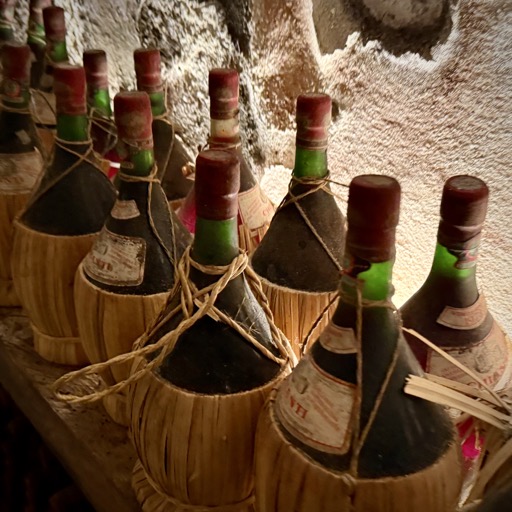
Chianti from the farm in the cellar beneath the castle.
They keep some of the original chianti wine that gave the wine such a bad reputation. Chiantis these days are exceptional.
The oldest wines in the cellar.
The original clay jars they used for olive oil production before stainless steel tanks. These are just for display.
Our Master Chef and trainer for the day: Jerry.First two are up making the pasta dough.Then make the sauces that will go on the pasta.Next step, rolling out the rested dough until you can see through it.Then cutting it, by hand. In the Master Chef’s words: ‘If you see red, stop.’We all graduated pasta cooking class!Now we get to enjoy lunch.Started with the antipasto made from products mostly from the farm.The final version of our hard work!
It turned out really good, surprisingly.
The wines from the farm we tasted.After a big pasta lunch, moving is slow.Heading back.
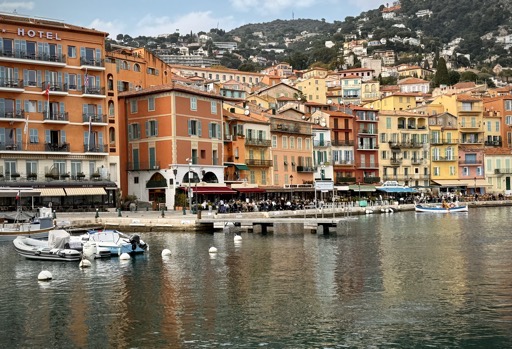
We docked on the famous Cote d’Azur near the small town of Villefrance-sur-Mer.
We tendered from the ship to the port and then went off to explore the principality of Monaco.
This whole area is so beautiful with charming coves and bays all along the coast. Of course, this area has been popular with the rich and famous for hundreds of years, so there is a cascade of mansions and palaces along the mountainsides that makes for a very scenic trip.
Good morning!Leaving the ship by tender.Villefrance-sur-Mer in the morning sun.
Our first stop in Monaco, the Musée Oceanographique de Monaco which was inaugurated in 1910 by Prince Albert 1. The famous deep see explorer, Jacques-Yves Cousteau, was director of the museum for more than 30 years.
The original deep sea submarine of Jacques-Yves Cousteau is on display outside the museum.
The decorations on the building are all sea creatures.
Cathedral of Our Lady Immaculate, also know as the Cathedral of Monaco, is a Romanesque-Byzantine Catholic church that contains the remains of many members of Monaco’s ruling family.
Grace Kelly’s final resting place.The palace of the Prince of Monaco.
The Prince was in residence so there was a lot of other security as well as the guards.
A view of the racetrack of Monaco which is now being prepared for a visit from the pope. The side of the hill behind is the district of Monte Carlo.
Walking the streets in Monaco.
Nice, capital of the Alpes-Maritimes department on the French Riviera, sits on the pebbly shores of the Baie des Anges. Founded by the Greeks and later a retreat for 19th-century European elite, the city has also long attracted artists. Former resident Henri Matisse is honored with a career-spanning collection of paintings at Musée Matisse. Musée Marc Chagall features some of its namesake’s major religious works
Walking around Villefrance-sur-Mer.
The Rue Obscure (Dark Street) in Villefranche-sur-Mer is a 430-foot long 13th-century covered passageway in the Old Town. Originally a defensive, open-air walkway for soldiers, it was later covered by houses, creating a dark, tunnel-like alleyway..
A copy of the painting by Jean Cocteau at the entrance to the Rue Obscure.
Waving goodbye as we head back to the ship.A final vista as the soft rain comes in.
Dinner tonight was a Korean tasting menu with wine pairing at the Chef’s Table.
It was a culinary feast that is difficult to describe in mere words, so let the pictures tell the story.
The Specialty Restaurant for tonight’s dinner.
Since South Korea is located at the southern end of the Korean peninsula, where cold currents and warm currents meet, it produces varied seasonal foods. Korean food is mainly barbecue, soup, rice and vegetable dishes. Anyone who has tried to make kimchi, a popular side dish consisting of spicy cabbage, would be impressed by this quintessence of Korean food culture. Korean barbecue is as famous as Korean kimchi and is loved by everyone.
In Korea, there is a saying that “food is one of the five blessings.” Korean food is characterized by five colors and five flavors. The five colors are red, white, black, green, and yellow, and are based on the Five Elements Theory. The colors are bright and beautiful, which are said to stimulate appetite.
The five flavors are sweet, sour, bitter, spicy, and salty. The five flavors mainly rely on rich seasonings and the seasonings are referred to as “Ta (yaonian)” in Chinese characters in Korea, which means “dishes with various seasonings are as beneficial to health as tonics.” One such indispensable ingredient is chili sauce. Korean food generally looks red and spicy, but there is actually a sweetness in Korean chili sauce, which makes it less spicy.
Tonight’s culinary voyage will allow you to taste refined Korean cuisine.
Commonly called “Körai chawan,” a bowl used for preparing and drinking tea, this small bowl of steamed eggs focuses on a smooth and delicate texture. The “umami” taste given by bonito flakes and kombu broth is light, but sweet. The combination of grilled seafood enhances the flavor of this home-cooked dish.
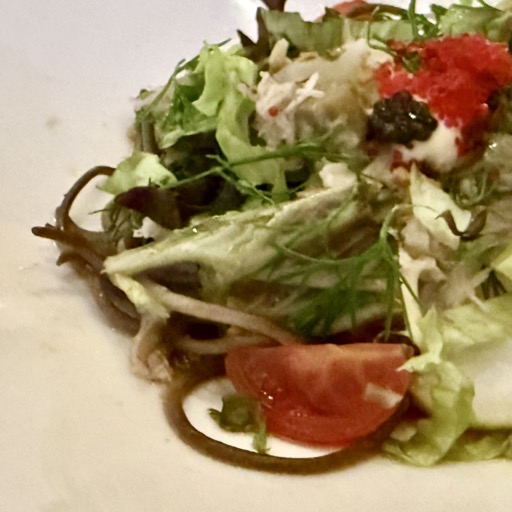
The ingredients of this salad are diverse, especially in the use of seafood. The sauce is a mix of Western and Asian flavors. This sesame-flavored seafood salad is sweet, fragrant and crisp in every bite.
SOUP
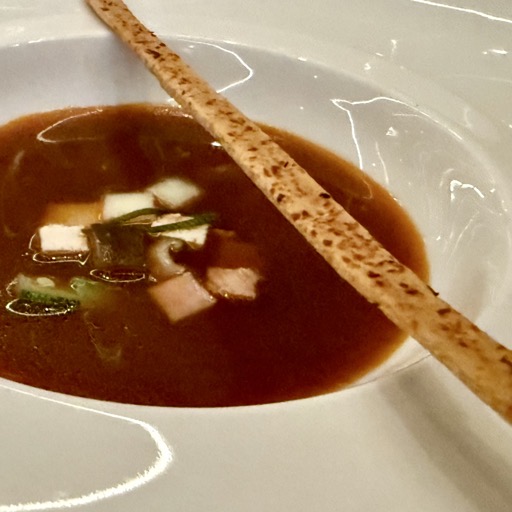
KOREAN SOUP POT smooth tofu, mushrooms, zucchini, pork belly, Korean bean paste broth
Soup has been loved by Koreans since the Joseon Dynasty. Soybean paste, a common soup ingredient, is very easy to mix with other flavors. When cooked with meat, tofu and vegetables, it is delicious and healthy.
MAIN COURSE
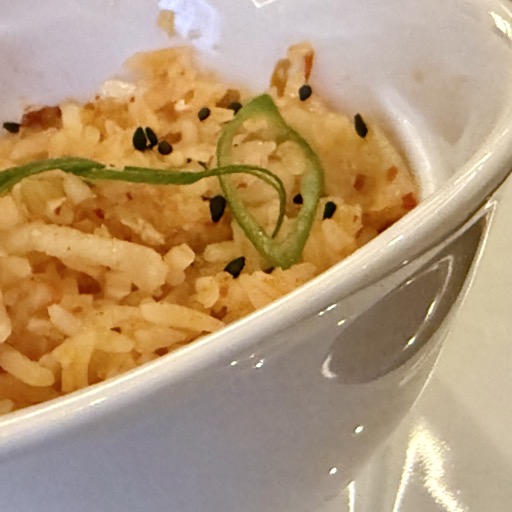
THE MORE BBQ, THE MORE PROSPEROUS barbecued Korean marinated beef short ribs, pickled onion, sweet potatoes, green lettuce, chill pepper, cucumber; Korean BBQ sauce; kimchi fried rice
Barbecue with kimchi is classic Korean cuisine.
Korean barbecue was introduced to ancient Korea from China. It originated from a method in Northeast China where the meat was first marinated and then grilled in order to preserve it for a longer period of time. This marinated, premium ribeye meat is served wrapped in lettuce, or with a bite of kimchi to add an extra layer of flavor.
DESSERT
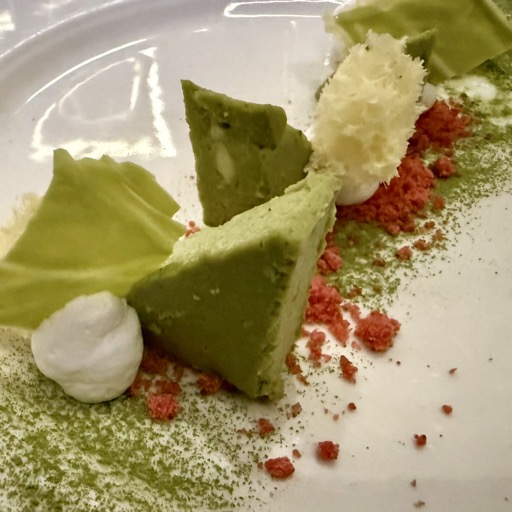
A TOUCH OF FRESHNESS matcha cheesecake, yuzu ice cream
This dessert combines matcha-an ingredient that has been used in Korea since the 7th century-with the baking technique of Western food, presenting a light and soft cheesecake. The slight bitterness of matcha and the refreshing taste of yuzu ice cream relieve the heaviness of the cheese, reflecting the harmony in Korean cuisine.
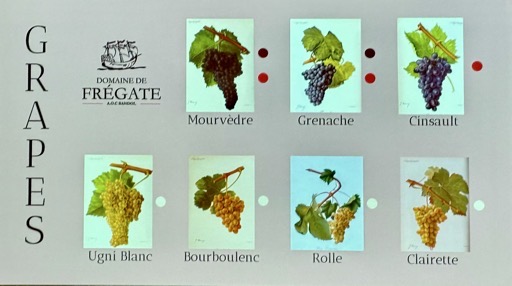
Todays exploration took us to the Bondol wine region.
The first stop was at the Domaine de Fregate wine cellars to learn more about the wines here, and have a tasting, of course.
They have been making wines here for about 25 centuries and this is one of the oldest AOC’s (Controlled Area of Origin) in France.
It was fascinating to learn how strict they are about the AOC certification. It even specifies how many vines you can have on a root (2), and how many bunches of grapes you can have per vine. (Max 6)
From there we went to the tiny little medieval village of Le Castellet perched on a cliff. The village itself was so picturesque and the views of the surrounding countryside breathtaking.
Good morning Marseille!Winery on top of the slope.The different varietals from the Bondol area.The city gate.
The location that was used in a French movie by Pagnol from 1932, called La Femme du Boulanger.
Were the front arch curves into the ceiling, you can see the (now closed) window from where the ruler of the village would attend service since they could not mix with the commoners.
The views from up here are breathtaking.This restaurant uses old gondola carriages as little eating rooms.
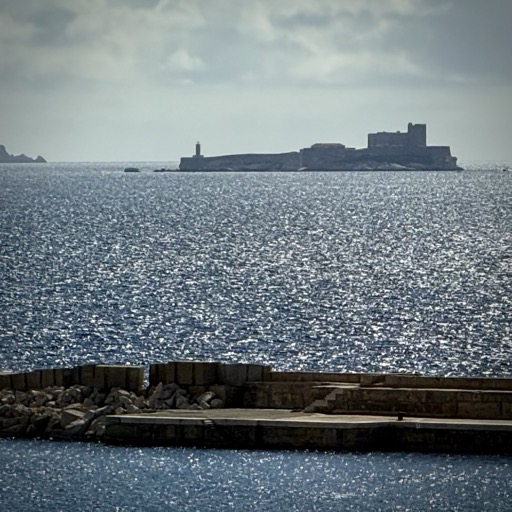
From our ship you can see the island where the Count of Monte Christo was imprisoned. Alexander Dumas was living in Marseille for part of the time while he was working on the story.
Our tour today started with a very informative stroll through the town of Sète.
It was settled more than two thousand years ago by the Greeks because of the hill surrounded by water that was easy to defend. The name Sète is derived from an old Roman word that means ‘whale’ since the Mont St. Claire hill looked like a whale to the sailors.
This is also the end point of the canal that was built by the french king to connect the North sea to the Mediterranean. There are now many canals so the town is also known as the ‘Venice of the Languedoc’ They also have a yearly ‘canal jousting’ competition.
The town sits next to the Ètand de Thau, a saltwater lagoon, where there are more than two thousand oyster beds. One of the main industries in town.
The other is of course wine, since it is the closest port to the Languedoc wine region.
After our city tour we were off to an oyster farm to get a closer look. Included was also an oyster tasting with a local wine which paired very well.
We watched the worker as she cemented baby oysters to a string. This will then hang in the lagoon for about three years before they get harvested.
Since there is no tide here, they never get out of the water and thus do not grow the strong muscle to close up, which makes them a lot softer.
The oyster place was dark and industrial and we were getting worried about where we were going to do the tasting. Our guide took us to a set of stairs and like a true speakeasy, it opened up into a fantastic seafood restaurant.
We gorged ourselves with the freshest seafood (and oysters, of course) with the wines made with the local Picpoul grape.
After lunch we went to a local wine farm to taste the other local industry, wine.
We had a few extra minutes so our guide was able to stop for us to do another tasting and buy some Picpoul wine.
A great day!
A very foggy morning.
Once an island, described by the poet Paul Valery as the ‘singular isle”, this port town owes its existence to Louis XIV and Paul Riquet’s major canal, built to link the Atlantic and the Mediterranean – now known as the Canal du Midi – which led to the creation of this new seaport in July 1666. Here there are neither city walls nor palace. The architectural heritage of Sète, which was spelt Cette until January 1928, gradually grew up around the development of its port.
Canals throughout town.It was market day!Spices.There is a local delicacy, an octopus pie, called ‘Tielle’The Royal Canal was built in 1666 by King Louis XIV
They were hand building a ship to get ready for a big boat festival that happens once every two years.
The view of Sète from on top of Mont St. Claire.Entering the are where we will learn about oyster farming in the lagoon.
First she lays out the baby oysters in groups of two and then strings a nylon rope over them.
After a blob of cement, a third oyster gets placed on top to hold the rope in place
These will now move to the oyster ‘bed’ in the lagoon to hang there for about three years.
The upstairs speakeasy restaurant.Yum.There are two thousand of these oyster beds in the lagoon.There are about five hundred ‘farmers’ sharing the oyster beds.Domaine Saint-Andre was created in 1785.Off to explore the cellars.Au revoir, Sète.
The focus of today’s trip was all about Gaudi and his architecture.
Our first stop was of course his pièce de résistance, the La Sagrada Familia. It is the largest Catholic church in the world under construction. Building started in March 1882 and a few weeks ago, on February 2026, it became the tallest church in the world. There is still many years of construction to go.
The outside is very ornate and tells all these biblical stories in dioramas of stone.
It is the inside that takes your breath away and makes you feel that you have been transported to a different place and time.
To quote: “It is a monument to Light”
And everything you see has a symbolic attachment to faith.
After a drive through town past some of Gaudi’s other great pieces, we got to Park Guell where he was commissioned to do a neighborhood of whimsical places in a park for the Nouveau Riche.
A fascinating day.
Barcelona morning.The city is full of art everywhere.Keep seeing faces in the architecture.
There is no photo that can convey the sheer drama and transformation entering this space.
The smaller part under the main church.A monument to light.
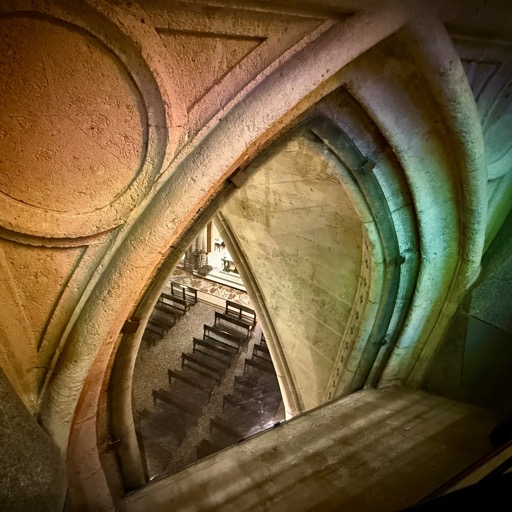
It is a massive organ that was being played while we were there. The acoustics were astounding.
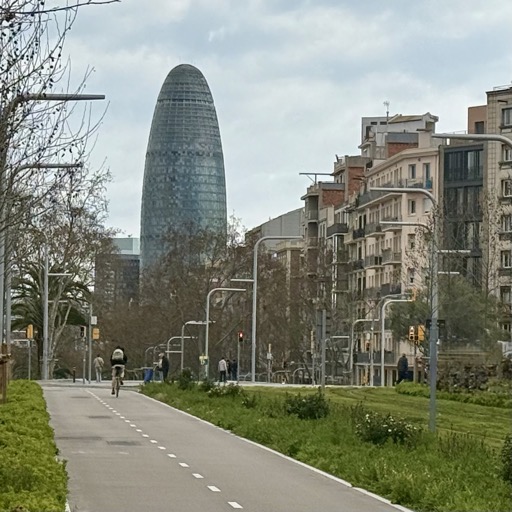
The locals lovingly call this building ‘The Suppository’
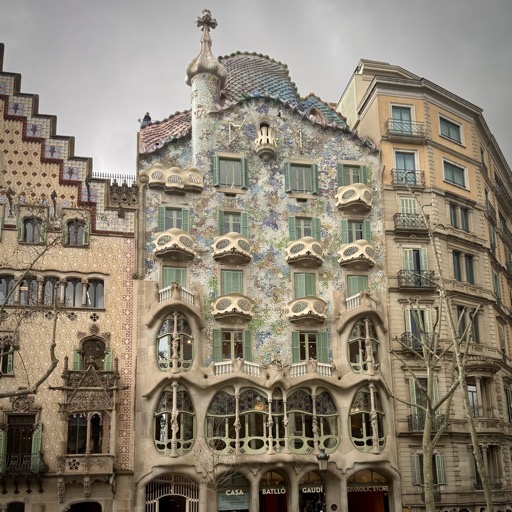
This house was commissioned to tell the story of St. George slaying the dragon. You can see the roof with the tiles as well as the balcony ‘skulls’. The chimney is the sword that he used.
At some point these Argentinian Parrots were released and they have now become an invasive pest.
The house in Park Guell that Gaudi lived in for a few years.
Park Güell has its origins in an urban development project that was awarded to Antoni Gaudí by Eusebi Güell, a prominent Catalan industrialist whose plan was to build 61 houses for well-to-do families, along with a network of roads, viaducts and stairs to make it easier to get around the hilly terrain. Güell wanted to recreate the British residential parks and locate homes close to nature. Hence why he called it Park Güell.
Work began in 1900 and finished in 1914 with the construction of the pillared hall (hypostyle hall) and the bench.
The Park is organised around a central core of monuments: the staircase, the pillared hall and the square.
Work came to an end and in 1922, following the failure of the urban development project, Güell sold the Park to the City Council, which opened it to the city as a public park.
1969 – Declared a historical-artistic monument by the Spanish government
1984 – Declared World Heritage by UNESCO
1993 – Declared Cultural Asset of National Interest by Catalonia’s autonomous government.
The reception building as you entered the main gate.The roof of the guard house.
Inside each if these columns is a pipe that funnels rain water from the catch basin above into the reservoir.
Gaudi was a pioneer in recycling.
Part of the wavey bench that surrounds the central space. He said that if the bench is straight people ignore each other, but on a wavey bench you are forced into groups facing each other.
To mis-quote Gaudi himself: “Beauty is not a question of money, beauty is a statement of art.”
Oir final show on the ship was a Catalan Rumba show. It was high energy and full of fun.